WA Regulations For Business CCTV: What Perth Businesses Need To Know
March 2, 2026
Warehouse security fails when access control is treated as one layer instead of a layered approach. A modern warehouse has more entry points, more contractors, more shift changes, and more high value goods moving through shared spaces than a typical office. Access control systems are essential for preventing unauthorized entry and managing who moves through shared spaces in warehouses, while also generating access logs that support security audits and investigations. The goal is not to slow operations, it is to control access without creating bottlenecks.
At Castle Security, we design warehouse access control to protect people, stock, and digital systems like Warehouse Management Systems. This guide breaks down the design patterns that actually work in real warehouse operations, including zone design, credentials, dock doors, integration with modern cameras, and the failure modes that cause most security incidents.
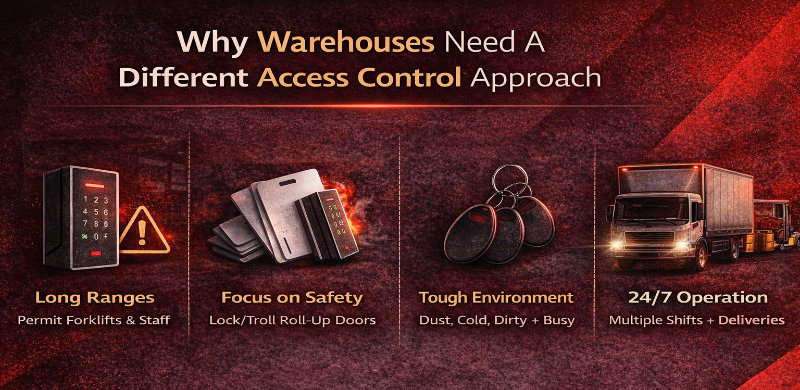
Warehouses are exposed to a mix of physical security and cyber physical risk. Delivery vehicles, loading docks, shared doors, and remote access create security gaps that attackers and insider threats can exploit.
Modern warehouses require a comprehensive security strategy that integrates physical and digital security measures. A compromised Warehouse Management System can lead to operational disruptions and financial losses, and it often starts with weak credential management or unauthorised access to networked areas.
A robust security system for warehouses must protect both physical inventory and digital records like inventory data, customer data, and financial data.
A warehouse security system works best when you design from the outside in. Layered Security Zones divide a facility into concentric zones, which reduces single points of failure and makes it harder for one mistake to expose the entire operation.
Use these tiers as a baseline:
This pattern limits access and reduces internal theft by separating duties and controlling who can enter sensitive areas.
Warehouse protection improves when every movement follows a controlled flow. You want transparency and accountability from the moment a truck arrives until product ships out.
A practical pattern looks like this:
This pattern reduces internal threats and makes investigations faster because access logs and video context align.
Role-Based Access Control limits insider risk by assigning permissions based on job roles rather than individuals. It also reduces admin mistakes during onboarding, shift changes, and labour hire surges.
A warehouse RBAC setup should map roles to zones:
This design improves warehouse safety by limiting who can easily access sensitive areas and reducing security threats created by shared credentials.
Shift change is where many warehouse access control systems fail in practice. If workers queue at a door, they tailgate. If they tailgate, access control measures lose value.
Use a throughput pattern that matches your headcount:
Layered secure entrances and full-height turnstiles significantly reduce unauthorized personnel gaining access to sensitive areas when implemented correctly.
The best credential for warehouse operations depends on speed, gloves, environment, and security level.
Badge Only works for general operations zone access when:
PIN Plus Badge is a strong step-up choice for:
Mobile Credentials can enhance operational efficiency by allowing quick movement between zones for authorised staff, while also supporting remote access management and faster credential revocation. Mobile works best when:
For high-security areas, biometric systems like fingerprint or facial recognition can be used, but only where workflows can support them without slowing operations.
Warehouse security is frequently compromised by weak credentials. Many warehouse sites still run legacy systems with prox cards and shared PINs.
For warehouses, use a credential strategy that matches today’s threats:
Regular credential audits are critical to ensure only current staff have access, lost badges are revoked, and expired access is removed. Expired or shared access codes often lead to unauthorized access, especially in labour hire environments.
If you want the detailed comparison, connect this guide to DESFire Vs Legacy Cards so your team understands the real upgrade path for cards, key fobs, and card reader selection.
Warehouses are harsh environments. Dust, vibration, long cable runs, and electrical noise from machinery expose the weakness of older reader wiring and protocols.
For a modern warehouse, OSDP is generally the stronger baseline, especially for dock doors, external readers, and high value zones where tamper detection and supervised communication matter.
If you want the deeper protocol breakdown, connect this page to OSDP Vs Wiegand For Access Control for the secure channel and wiring detail.
Dock door access is not the same as office door access. Door hardware must match operational reality.
For roll-up doors and dock doors:
A common failure mode is hardware that works on day one but fails after repeated impacts, exposure, or vibration. The fix is to treat door hardware and access control as one system, not separate trades.
Not every door needs to be online. Not every door should be offline. The design pattern that works is hybrid.
Use Online Doors for:
Use Offline Or Edge Controlled Doors for:
A centralized strategy still matters. Unified or cloud-based access platforms centralize management systems and allow real-time management of access across multiple sites, even when some doors operate in offline modes.
Integrated security systems allow high-level protection without disrupting operational workflows. Warehouses benefit most when access control is integrated with modern cameras, alarm system logic, and visitor systems.
A practical integration stack includes:
Surveillance systems should provide 24/7 coverage to ensure consistent protection, especially around loading docks, perimeter doors, and high value zones.
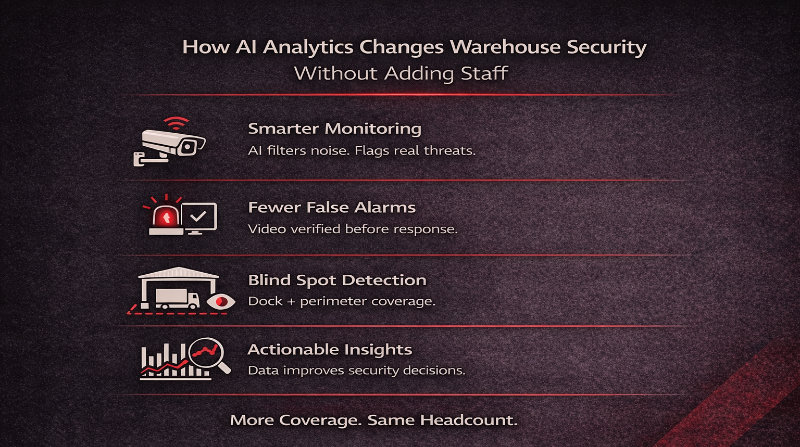
Modern warehouse security systems are increasingly used for proactive management rather than just recording.
AI-enabled smart cameras provide real-time surveillance and reduce reliance on on-site security personnel. AI technology can automate threat detection in surveillance systems, reduce false alarms, and improve response times.
AI-driven video analytics can improve threat identification accuracy by up to 60% when configured correctly, especially for:
Machine learning models are most effective when paired with strong access control measures. Cameras tell you what happened, access logs tell you who was authorised, and together they close security gaps.
Not every warehouse needs a mantrap, but high-risk warehouses benefit from controlled access points.
Use these controls when:
Mantrap systems ensure one person enters at a time in high-security areas and prevent piggybacking. Turnstiles and anti-passback reduce credential sharing and improve accountability.
Tailgating and insider threats account for a large portion of warehouse security failures when controls are weak. A layered approach makes it harder for these behaviours to become normalised.
Access schedules reduce risk without adding friction when they align to warehouse operations.
Best practice schedule design includes:
Time-limited access restricts entry to specific areas during authorised times and minimises unauthorised activity. It also improves investigations because an access event outside schedule is immediately meaningful.
A solid security strategy recognises that everything in a warehouse facility is connected. Modern warehouses face a mix of physical and digital security threats that require an integrated approach.
Cybercriminals target logistics and transportation sectors, and warehouses are prime targets because digital systems control physical outcomes. Network segmentation reduces risk by isolating security systems from general corporate traffic and from operational technology networks.
A comprehensive security solution should include cybersecurity protocols to protect:
A significant portion of data theft incidents in the sector are linked to compromised credentials. Secure credentials, RBAC, and proper monitoring reduce that exposure.
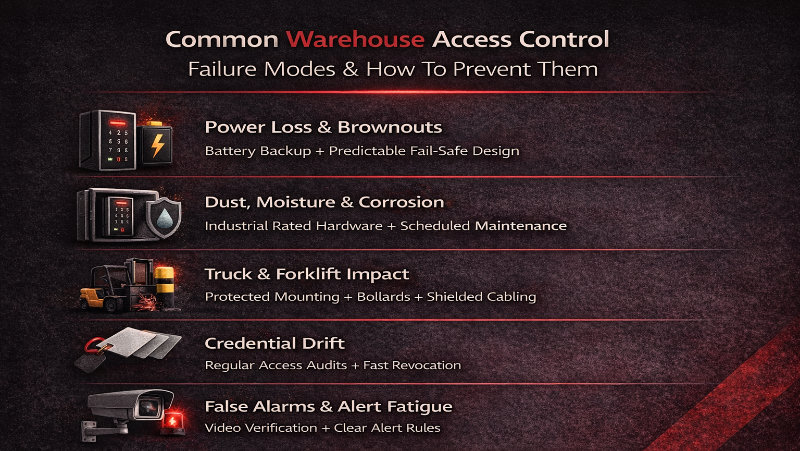
Warehouse access control must survive real-world impacts, not just pass commissioning.
Common failure modes include:
Unauthorized access has driven a 30% rise in asset loss and downtime over three years in many organisations. The fix is design discipline and continuous 24 hour security monitoring, not more locks in random places.
A Perth logistics warehouse approached Castle Security after repeated security incidents around loading docks and a pattern of internal theft that was hard to prove. The site needed better warehouse protection without disrupting dispatch.
We implemented a layered approach:
The result was a more secure environment with stronger audit trail visibility, fewer security gaps around loading docks, and clearer accountability without slowing shift change throughput.
The patterns that work best are layered security zones, role based permissions, controlled flow from gate to dock, and integrated security systems that link access logs with cameras and alarm system events.
Prevent bottlenecks by using turnstiles or wide supervised lanes, choosing fast credential types, staggering start times by department, and ensuring reader feedback is clear so staff do not hold doors open.
Use badge-only for general operations zones, step up authentication like PIN plus badge for high value storage, and secure smart credentials such as DESFire or SEOS to reduce cloning attacks and compromised credentials.
OSDP is typically the better choice for warehouses because it supports supervised, bi directional communication and better diagnostics. Wiegand is common in older systems but lacks encryption and supervision.
Design dock door access with industrial rated hardware, protected reader placement, door position monitoring, and role-based access schedules so only authorised personnel can open dock doors during approved times.
Common failure modes include power issues, dust and corrosion, truck impact near loading docks, credential drift from poor offboarding, and false alarms from unverified alerts.
Warehouse access control works when it matches how a warehouse actually runs. A layered approach that combines perimeter security, access control systems, modern cameras, an alarm system, and strong credential governance reduces security incidents without slowing warehouse operations. Design patterns like layered zones, role based permissions, secure credentials, and integrated access events give you continuous monitoring, a reliable audit trail, and better protection for high value storage and sensitive data.
If you want a warehouse access control plan that protects stock and staff without creating bottlenecks,
Castle Security can run a site audit and design consult across your entry points, loading docks, restricted zones, and credential workflows. Contact Castle Security to book a warehouse security design review and get a practical access control roadmap tailored to your warehouse operations.