WA Regulations For Business CCTV: What Perth Businesses Need To Know
March 2, 2026
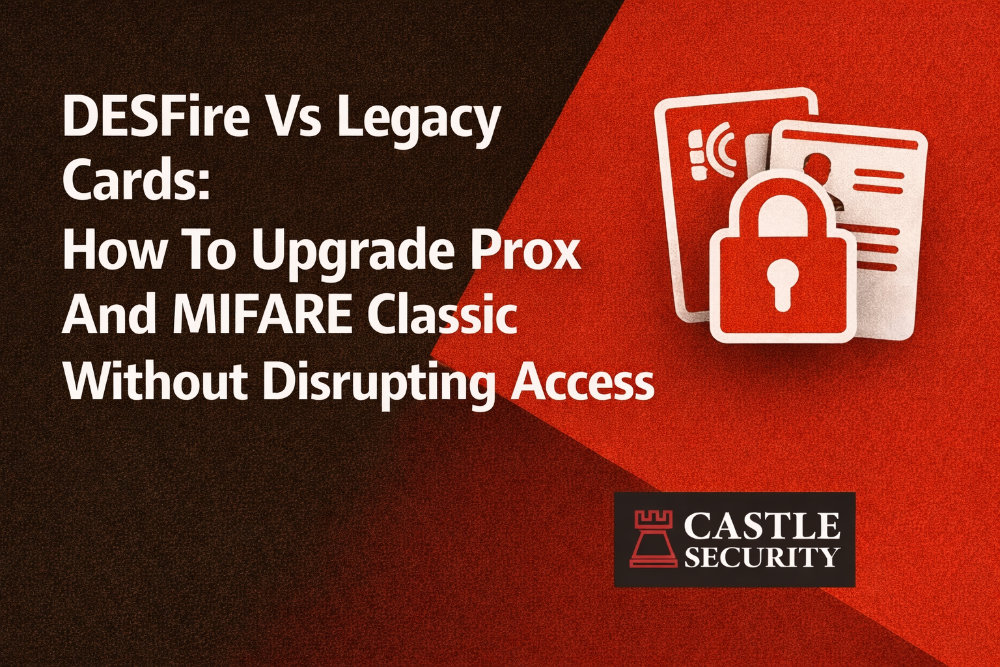
If your site still uses prox cards or MIFARE Classic cards, you are relying on legacy credentials that were built for convenience and low cost, not modern threat models. DESFire vs legacy cards is a security and migration decision, not a marketing preference. MIFARE DESFire is widely adopted in public transport payment systems, universities, municipalities, and financial institutions because it supports strong cryptography, secure messaging, and multi application use on one credential.
At Castle Security, we plan credential upgrades in a way that keeps doors operating, reduces cloning risk, and fits your budget. This guide explains what to upgrade first, which readers you need, how formats and site codes work, and how to avoid common mistakes like MIFARE CSN only deployments.
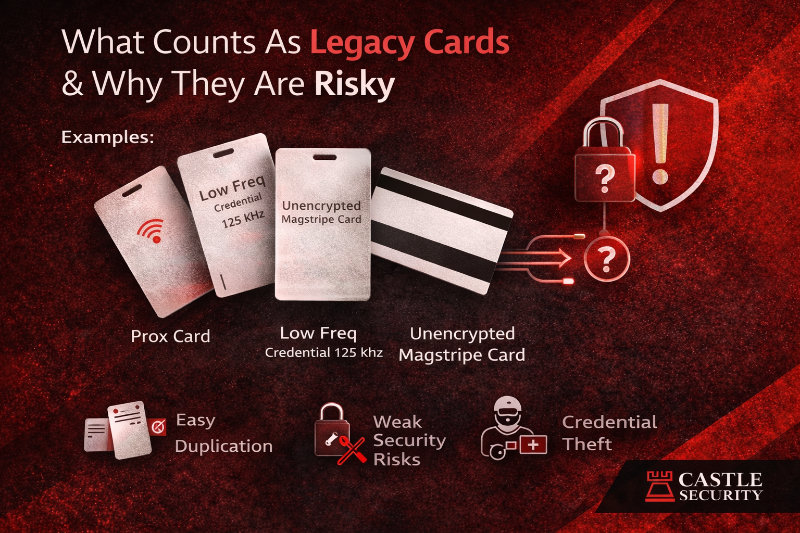
Legacy cards usually fall into two common groups in an access control system.
125kHz proximity credentials are the classic “tap to open” access cards used across many legacy systems. They are often called prox, proximity, or HID Prox depending on brand. These traditional cards transmit a card number without encryption. That creates a low security credential type because attackers can copy the data and emulate it.
MIFARE Classic is part of the MIFARE family of 13.56 MHz mifare cards. It is commonly referred to as a contactless smart card, but many mifare classic legacy products are vulnerable due to known weaknesses in their older cryptography. In real terms, that means a determined attacker can extract stored data and reproduce the credential.
If you are dealing with data centres, critical areas, or high value inventory, these weaknesses translate into real operational risk: card cloning, unauthorised access, and incident response costs that dwarf the price of upgrading credentials.
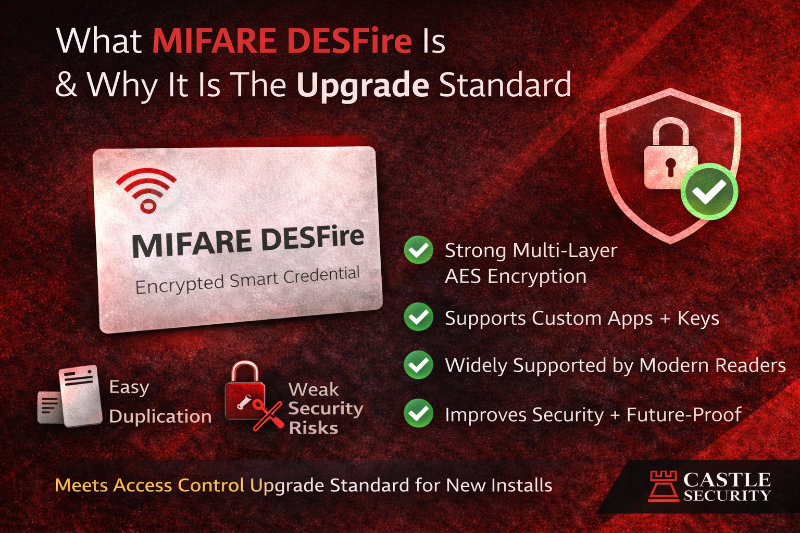
MIFARE DESFire is smart card technology built for high security. DESFire credentials support strong encryption, secure mutual authentication, and secure messaging between the card and the reader.
A DESFire credential can hold multiple secure applications on the same chip, which is why it is used across different sectors. Examples include:
DESFire is also practical. A DESFire card is designed for durability with around 100,000 read write cycles, which matters for daily access use.
When people search “DESFire vs prox”, they are usually trying to quantify risk. Here is the plain reality.
Prox cards (125kHz) transmit credential data without encryption. That makes them easy to clone using widely available tools. A copied credential can be used to gain access at any door that trusts that card number and facility code.
Common real world scenarios include:
DESFire mitigates these risks with mutual authentication and AES encryption. The reader and the card verify each other before data exchange, which prevents simple interception and replay attacks. If you have a site with a clear security level requirement, DESFire is the faster path to “secure by default”.
If you have both prox and MIFARE Classic across your estate, prioritise based on exposure and consequence.
Upgrade first when:
In many environments, prox is the most urgent because it is low security by design. MIFARE Classic can also be high risk depending on the application and card configuration. The best approach is to map doors by risk, then implement a phased migration that upgrades readers and credentials in priority order.
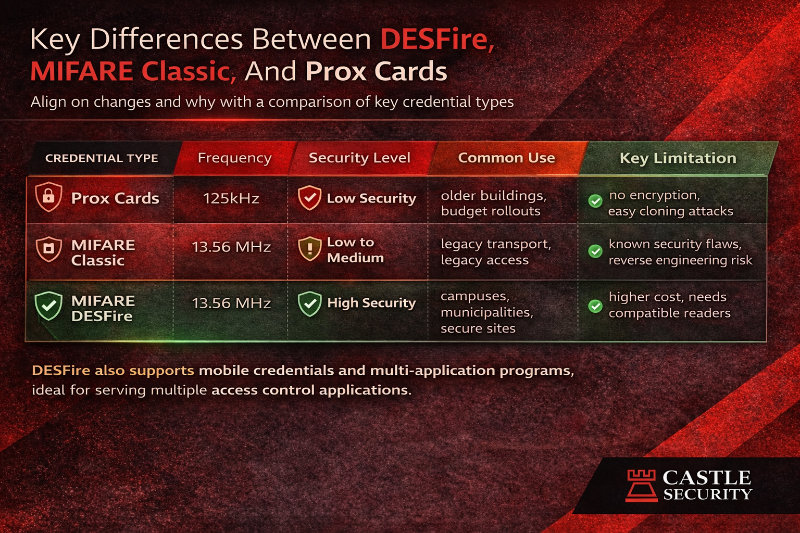
This comparison helps stakeholders align on what changes and why.
| Credential Type | Frequency | Security Level | Common Use | Key Limitation |
|---|---|---|---|---|
| Prox Cards | 125kHz | Low security | older buildings, budget rollouts | no encryption, easy cloning attacks |
| MIFARE Classic | 13.56 MHz | Low to medium | legacy transport, legacy access | known security flaws, reverse engineering risk |
| MIFARE DESFire | 13.56 MHz | High security | campuses, municipalities, secure sites | higher cost, needs compatible readers |
DESFire also supports more modern use cases like mobile credentials and multi application programs, especially where you want one credential to serve multiple access control applications.
DESFire typically requires 13.56 MHz readers with DESFire support. In HID ecosystems, that often includes multi technology reader families such as multiCLASS or Signo, depending on your required credential types and future roadmap. Other manufacturers also provide compatible readers, but the important point is capability, not branding.
When selecting a card reader, validate:
If you are upgrading from prox, note that migration may necessitate upgrading legacy systems to support 13.56 MHz readers. Many sites choose multi technology readers so they can accept old and new credentials during the cutover.
Yes. This is how most upgrades succeed without disrupting access.
Two practical approaches work well:
A progressive upgrade can be performed using either dual technology cards or multi technology readers which allows you to transition to smart technology at your own pace. This is especially useful when you have contractors, multiple tenants, or sites where you cannot reissue all cards in one week.
If you are starting fresh, choose the latest evolution you can support across your card supply and reader firmware.
DESFire EV3 is the current mainstream choice for new deployments because it offers enhanced security features over earlier generations and is designed to resist modern cloning and reverse engineering attempts. DESFire EV3 is built to meet higher security requirements and is widely positioned as the strongest option within the DESFire family.
EV2 can still be appropriate when:
In practical terms, your decision is less about the label and more about ensuring your encoding, key management, and reader support are correct across the whole estate.
No. “DESFire compatible” can be a trap if configuration is weak.
DESFire cards support AES 128-bit encryption, secure messaging, and multiple secure applications per card. But the system is only as secure as the way you implement it.
Configuration mistakes that reduce security include:
If you want high security, you must use secure data, secure keys, and mutual authentication correctly.
This is where many projects win or fail.
A standard deployment often relies on a known card format and encoding approach supported by your access control platform. A “custom encoded” DESFire credential typically means you are using a customised data structure, application layout, and key set that better matches your threat model and reduces the risk of credential duplication.
Custom encoding can increase security and control, but it requires:
For many organisations, the best practice is to start with a secure supported format, then move to custom encoding when governance is mature.
Legacy credentials often rely on a facility code and card number that are easy to copy. When you move to DESFire, you can still preserve the operational concept of site codes and numbering, but the data can be stored and protected differently.
Key points to plan:
This matters because your card management team still needs a quick and easy way to identify credentials, even when the actual credential data is encrypted.
In most cases, DESFire is a reader and credential decision, not a panel replacement decision. The access control panel typically sees a credential number or token that the reader passes to the controller.
However, there are two critical checks:
Some older controllers or legacy systems may constrain what formats are supported, which can limit how much of DESFire’s security features you actually use. This is why the reader selection and configuration stage is where the engineering matters.
A secure credential is one that uses strong encryption, mutual authentication, and resists cloning. Common secure options include:
The best choice depends on your existing card technology, reader ecosystem, and whether you want multi application capability. DESFire is widely used outside a single brand ecosystem and is especially common in transport and multi use environments. SEOS and iCLASS SE can be strong choices in HID aligned estates, particularly when combined with hid mobile access for mobile credentials.
CSN stands for card serial number. Many DESFire cards expose a serial identifier that can be read quickly. Using only the CSN for access decisions is a low security approach because the system is not using the protected stored data and encryption keys that make DESFire highly secure.
To prevent CSN only implementations:
This is one of the most common pitfalls we see when organisations attempt a DIY upgrade.
Credential upgrades affect workflows, not just hardware.
Expect changes in:
The upside is a cleaner security posture and better lifecycle control. The trade off is that issuance needs to be treated like a controlled process, not an ad hoc admin task.
A phased migration reduces risk and avoids disruption. A practical plan includes:
At Castle Security, we typically pilot on 2 to 5 doors first, validate reader configuration and card data handling, then scale across the site.
It is normal for DESFire cards to cost more than prox cards. DESFire credentials use advanced microprocessors and encryption modules, and the implementation includes configuration work that legacy credentials do not require.
Cost drivers include:
Worth noting: transaction speed may be slower with DESFire due to mutual authentication, but in most real access control applications the difference is not noticeable to users when the system is configured correctly.
In practice, DESFire reduces incident risk and cloning exposure, which is the cost that most sites underestimate until an event occurs.
A Perth based commercial site came to us after a lost prox credential was suspected of being copied. They wanted an upgrade that did not disrupt daily operations across multiple entry points.
We implemented a phased migration using multi technology readers and dual technology cards, starting with after hours access doors and sensitive areas. The site kept existing access control panels, upgraded readers in stages, and moved staff to DESFire based credentials while legacy credentials were retired on a defined cutover date. The outcome was a higher security level credential program with clearer issuance controls and a practical path to mobile credentials in future.
Yes. 125kHz prox cards transmit data without encryption, which makes them vulnerable to cloning attacks using readily available equipment.
In many cases, yes. The upgrade is often reader and credential focused, with the access control system and panels remaining in place if they support the required reader interfaces and formats.
Usually, yes. DESFire typically requires 13.56 MHz readers that explicitly support MIFARE DESFire and the secure formats you plan to use.
Yes. Use dual technology cards or multi technology readers so staff can badge in during the transition without losing access at non upgraded doors.
Relying on MIFARE CSN only implementations. It reduces the security benefits of DESFire because the system is not using secure stored data and encryption keys.
In most new deployments, yes. DESFire EV3 is the latest evolution of the MIFARE DESFire family and is designed for high security applications when implemented with correct configuration and key management.
If you are still using prox cards, MIFARE Classic, or other low security legacy credentials, now is the time to plan an upgrade before vulnerabilities lead to costly incidents. MIFARE DESFire EV3 provides strong security features like mutual authentication and AES 128-bit encryption, and it supports multi application use across access control systems, campus services, hospitality, and event environments. The key is implementation quality, especially avoiding CSN only setups and planning a phased migration that fits your existing infrastructure.
If you want a clear upgrade plan, Castle Security can review your current credential types, readers, and issuance workflow, then design a phased migration that improves security without disrupting operations. Contact Castle Security to book a credential audit and get a DESFire migration plan tailored to your site.