Cloud Vs On Prem Access Control What Changes In Real Deployments
February 10, 2026
Choosing between OSDP vs Wiegand for access control comes down to security, reliability, and how future proof your access control systems need to be. Wiegand is a legacy communication protocol with only one way communication and no encryption. OSDP is the Open Supervised Device Protocol that enables bi directional communication, encrypted communication, and supervised communication between access control devices. For most new projects in Perth, OSDP secure channel is the safer baseline for secured access doors.
The Wiegand protocol is a long running communication protocol used to connect an access control reader to an access control panel or door controller. Many legacy systems still use it because it is simple, widely compatible, and familiar to technicians.
Wiegand readers typically transmit data one way from the reader to the controller using two data lines, commonly called D0 and D1. That simplicity is also the core limitation: only one way communication means the controller cannot confirm what is happening at the reader beyond basic credential reads.
OSDP protocol stands for Open Supervised Device Protocol and it was developed by the Security Industry Association to improve interoperability and security in physical access control. You will also see it written as supervised device protocol OSDP or supervised device protocol osdp.
OSDP uses RS 485 wiring and supports two way communication and bidirectional communication between access control devices. That allows the controller and OSDP readers to exchange status, configuration, and diagnostics data, not just credential data. In a modern access control system, that shift improves operational efficiency and makes it easier to manage evolving threats.
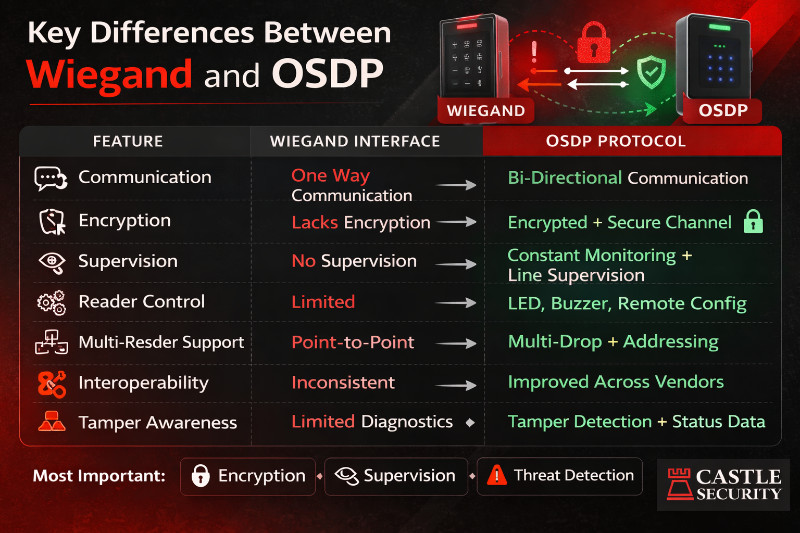
The quickest way to understand wiegand and osdp is to compare security, supervision, and capability.
| Feature | Wiegand Interface | OSDP Protocol |
|---|---|---|
| Communication | One way communication | Bi directional communication |
| Encryption | Lacks encryption | Encrypted communication with secure channel |
| Supervision | No supervised communication | Constant monitoring and line supervision |
| Reader Control | Limited | LED, buzzer, remote configuration |
| Multi Reader Support | Point to point | Multiple readers with multi drop addressing |
| Interoperability | Widely used but inconsistent | Improve interoperability across different vendors devices |
| Tamper Awareness | Limited diagnostics | Tamper detection and richer status data |
Key differences that matter most in real sites are encryption, supervision, and the ability to detect security threats before they become unauthorised access.
OSDP secure channel vs Wiegand is not a close contest when sensitive data is involved.
If you are protecting high value areas or any site with clear compliance requirements, OSDP provides encrypted, supervised communication, which is why it is widely considered the best choice for secure environments.
OSDP uses RS-485 wiring, which is a serial standard designed for longer runs and noisier environments than many older approaches.
A typical OSDP reader run uses:
In practical terms, OSDP can use less cable overall on sites with multiple readers because you can run a shared RS-485 trunk and address readers on the same bus.
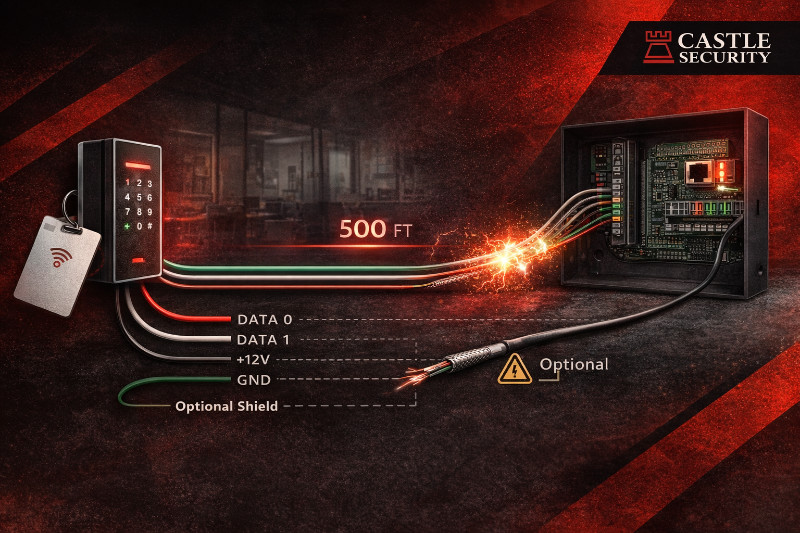
Wiegand is usually wired as point to point from each reader back to the controller. A typical run includes:
The maximum cable distance for Wiegand is limited to 500 feet, around 150 metres, and performance can degrade sooner if the environment is noisy or if cable quality is inconsistent. Because Wiegand is not supervised, wiring issues are often discovered only after failures impact granting access.
You can sometimes reuse existing cable, but it depends on the conductors available and the quality of the run.
A common upgrade approach is to reuse power conductors and repurpose a twisted pair for data, but only after testing continuity, insulation resistance, and noise susceptibility. For secured access doors where risk tolerance is low, new cabling is often the cleanest long term option.
OSDP generally performs better in electrically noisy environments because RS-485 is designed for robust differential signalling. That matters in commercial sites with lifts, motors, dock equipment, plant rooms, or long cable paths.
Wiegand can work reliably in many office environments, but it has fewer tools to detect or correct issues. When interference occurs, you may see sporadic credential reads, inconsistent user feedback mechanism behaviour, or unexplained access denials that are hard to diagnose.
Start with the panel or door controller specifications. You are looking for:
If the panel supports OSDP but only in basic mode, you may not get secure channel or advanced features. For a modern access control system, confirm secure channel support before you commit.
Not all “OSDP readers” support secure channel. Check:
If the reader supports OSDP but not secure channel, you still gain two way communication, but you miss the strongest protection against interception and replay attacks.
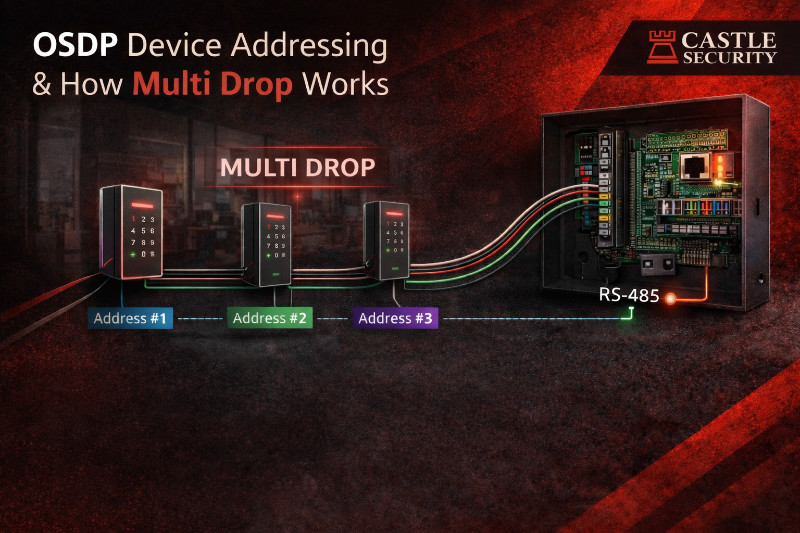
OSDP supports device addressing, which allows multiple readers to share a single RS-485 connection. Each device is assigned an address so the controller can poll readers and manage responses without collisions.
Multi drop is useful when:
When designed correctly, multi drop reduces wiring complexity and can improve interoperability across vendors devices in the same entire system.
A stable RS-485 bus needs correct electrical practices. Best practice includes:
These steps improve supervised communication stability and reduce “ghost faults” that waste maintenance time.
Most OSDP issues come down to addressing, wiring polarity, termination, and power.
Use this checklist:
Because OSDP supports bi directional communication, you can often pinpoint where failures occur instead of guessing, which improves operational efficiency.
OSDP allows the controller to send commands back to the reader. That supports remote configuration and, on compatible ecosystems, remote firmware management. In practical terms, it means you can deploy updates that improve security and performance without visiting every door, depending on the reader and controller capabilities.
This matters when threats evolve or when you need to ensure compliance across many secured access doors.
OSDP supports richer data exchange than Wiegand, which makes it better suited to advanced authentication methods and devices like:
Wiegand can carry credential bits, but it does not provide the same level of device management, diagnostics, or feature control.
OSDP improves the quality of monitoring because the controller can supervise the link and receive device status. That can support:
A key weakness with Wiegand is that it cannot reliably detect if a reader has been removed or replaced until failure occurs. On higher risk doors, that gap can translate into unauthorised access.
Migration succeeds when you plan around compatibility and cabling realities.
Common pitfalls include:
At Castle Security, we treat migration as a staged upgrade so you can enhance security without replacing the entire system in one hit.
Interoperability is a key promise of OSDP, but real world compatibility still depends on implementation.
A practical compatibility matrix checks:
If you run mixed estates, we recommend validating a small pilot door first before scaling across the site.
Cost is not just hardware. It includes labour, commissioning time, and ongoing support.
For new builds, choosing OSDP readers is usually the simplest path to a future proof design with better security.
The commonly quoted limit is 500 feet, around 150 metres, but real performance depends on cable quality, interference, and installation workmanship.
OSDP works best on twisted pair suitable for RS-485. Many security cables include twisted pairs that are appropriate, especially when shielded and correctly grounded.
Yes. Two practical migration paths are replacing Wiegand readers with OSDP readers, or using a converter to bridge legacy Wiegand at the edge while moving the backbone to OSDP.
OSDP supports secure channel with AES-128, but encryption depends on both the controller and the reader supporting secure channel and being configured correctly.
Yes. OSDP enables more device status reporting and supervision, so tamper events and link faults can be detected earlier than with Wiegand.
If your priority is better security, cleaner diagnostics, and a modern access control systems that can adapt to evolving threats, OSDP secure channel is the clear upgrade from Wiegand protocol. It protects sensitive data with AES-128 encrypted communication, enables supervised communication, and supports advanced features like device addressing, remote configuration, and multi drop wiring for multiple readers.
If you want help choosing the right approach for your site, Castle Security can assess your existing access control panel, readers, and cabling, then recommend the best migration path from legacy systems to OSDP without unnecessary replacement. Contact us to book an access control review and get a practical upgrade plan for your secured access doors.